
CCSP Certification Roadmap Recap: Key Takeaways and Resources

The Cybersecurity Club kicked off 2026 with a virtual training session on the Certified Cloud Security Professional (CCSP) certification.
The session was led by Mbong “Hudson” Ekwoge, Founder of Cloud Brewery and Cloud Infrastructure Lead at Woolworth Financial Services.
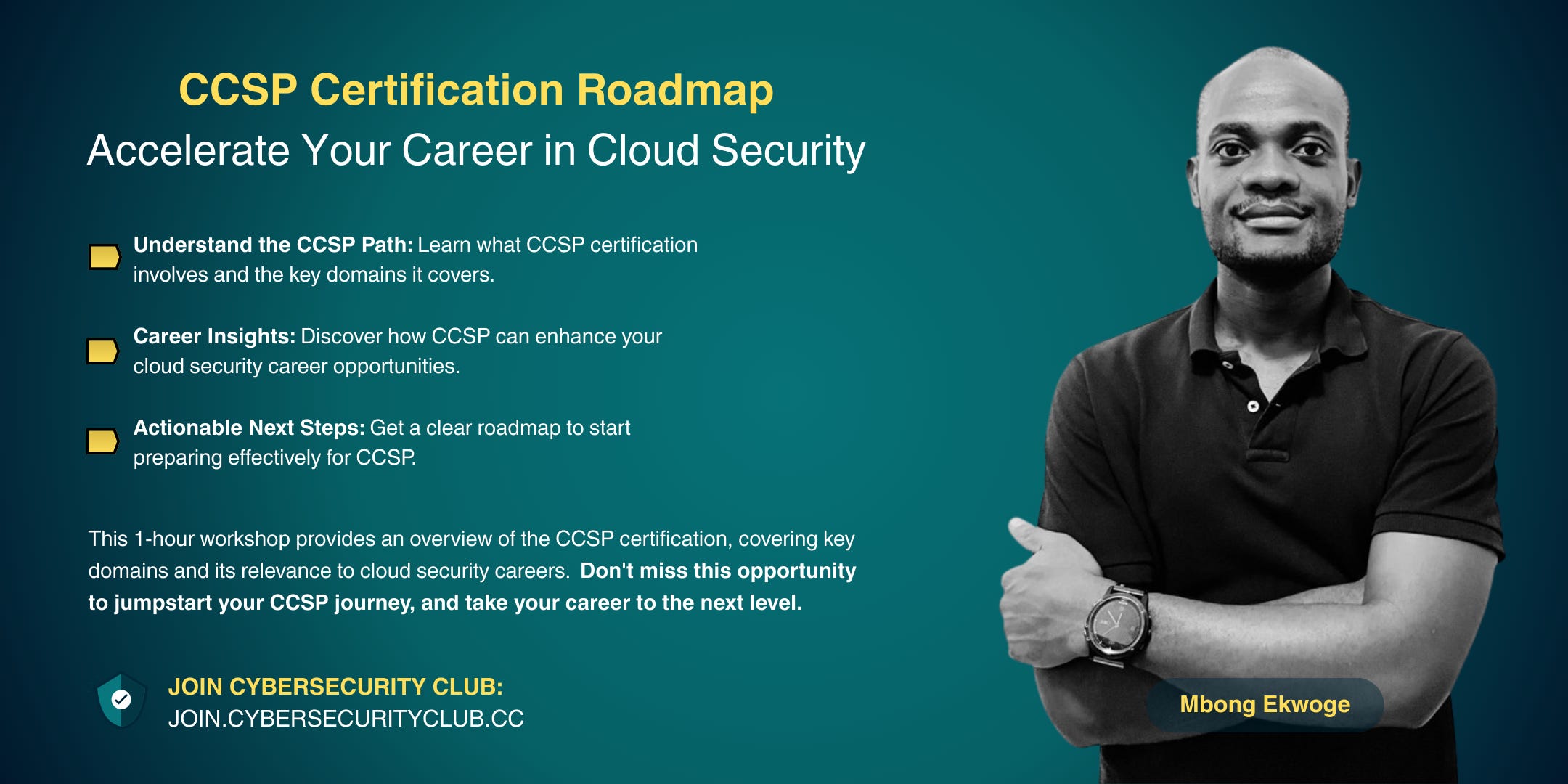
With more than 20 years of experience in IT, networking, and cybersecurity leadership, Hudson shared practical insights on how the CCSP can help professionals advance their careers in cloud security.
He explained that the certification not only builds credibility but also deepens understanding of how to secure modern cloud environments.
Hudson described the CCSP as a bridge between technical expertise and business strategy. He emphasized that professionals who align cloud security practices with organizational goals are better equipped to lead secure digital transformations and strengthen business resilience in a cloud-first world.
“The CCSP helps you connect the dots between technology and business. Real cloud security isn’t just about tools—it’s about understanding how those tools protect what matters most to the organization.” - Hudson Ekwoge
The session offered clear, actionable advice on study strategies, certification preparation, and career development.
It concluded with an interactive Q&A that connected CCSP knowledge to real-world applications in cloud security and DevSecOps.
From Network Engineer to Cloud Security Leader
Hudson’s career began in network engineering, where he worked with technologies such as Cisco, Huawei, and Juniper to design and maintain enterprise infrastructure.
Over time, his responsibilities expanded into systems administration and telecommunications, giving him a strong foundation in how networks and systems interconnect.
He shared that much of his early work involved “building things securely without knowing why,” a realization that later motivated him to pursue advanced cybersecurity certifications like CISSP and CCSP.
These certifications reshaped his perspective—helping him understand the strategic importance of aligning technical controls with business objectives.
Today, Hudson serves as Cloud Infrastructure Lead at Woolworth Financial Services, where he oversees secure cloud operations, governance, and compliance.
Through his platform Cloud Brewery and his Udemy CCSP course, he continues to mentor professionals worldwide, bridging the gap between technical expertise and business-driven cloud security leadership.
💬 Q&A Highlights
The Q&A portion of the session allowed participants to explore practical aspects of preparing for the CCSP exam and applying cloud security principles in real-world scenarios. Here’s some of the highlights:
Q1: How does CCSP differ from CISSP?
Hudson explained that while both certifications are offered by (ISC)², they serve different purposes. The CISSP is broader, covering general information security principles across multiple domains such as network security, access control, and cryptography.
The CCSP, on the other hand, focuses specifically on cloud environments, addressing topics like cloud architecture, data security, and compliance in multi-tenant infrastructures. For professionals already holding a CISSP, pursuing CCSP helps deepen their expertise in cloud-specific security challenges and frameworks.
Q2: What’s the best way to start preparing for CCSP?
Hudson recommended beginning with the domains you already understand to build momentum, then gradually moving into more complex areas such as legal, risk, and compliance.
He emphasized the importance of using multiple study resources, including official (ISC)² materials, online courses, and practice exams.
He also encouraged learners to join study groups or online communities to discuss real-world scenarios and clarify difficult concepts. Consistency and hands-on practice were highlighted as key success factors.
Q3: How is AI impacting cloud security?
Hudson discussed how artificial intelligence is transforming both offensive and defensive aspects of cybersecurity. On the defensive side, AI enables faster threat detection, anomaly identification, and automated incident response.
However, attackers are also leveraging AI to create more sophisticated phishing campaigns and exploit vulnerabilities at scale. This dual impact means that cloud security professionals must stay informed about emerging AI-driven tools and continuously adapt their defense strategies.
Q4: Are free CCSP courses worth it?
Hudson affirmed that free courses can be valuable, especially for those starting out or exploring new topics. He advised participants to verify the credibility of the source and use free materials to supplement structured study programs.
Free resources such as YouTube tutorials, open-source labs, and community webinars can help reinforce foundational knowledge before investing in paid certifications or advanced training.
Q5: What career opportunities does the CCSP provide?
Hudson noted that CCSP certification can lead to roles such as Cloud Security Architect, Security Consultant, Compliance Manager, or Cloud Governance Specialist.
The credential signals to employers that the holder understands both the technical controls and business implications of securing cloud environments. It also demonstrates readiness to contribute to strategic decision-making in organizations adopting or expanding cloud infrastructure.
Q6: How can developers integrate security into their workflows?
Hudson encouraged developers to adopt a DevSecOps mindset, embedding security checks throughout the software development lifecycle. He suggested using automated tools for code scanning, dependency management, and configuration validation.
By integrating security early, teams can reduce vulnerabilities, improve compliance, and foster a culture of shared responsibility for secure cloud operations.
These discussions provided attendees with practical insights into both the technical preparation for CCSP and the strategic mindset required to apply cloud security principles effectively in real-world environments.
📚 Resources
To help participants continue their learning journey beyond the session, the following resources were shared and discussed. Each was selected to support a specific stage of professional growth in cloud security and DevSecOps.
1. TechWorld with Nana – DevOps Bootcamp
What it is: A comprehensive, beginner-friendly course that covers DevOps fundamentals, including CI/CD pipelines, containerization, and cloud deployment.
Why it matters: Many CCSP candidates come from development or operations backgrounds. This course helps bridge the gap between software delivery and secure cloud operations—an essential foundation for understanding how security integrates into modern cloud workflows.
Link: https://www.techworld-with-nana.com/
2. Hudson’s CCSP Course on Udemy
What it is: A structured online course created by Hudson, focusing on the six CCSP domains—covering cloud architecture, governance, risk, compliance, and operations.
Why it matters: This course provides a guided path to mastering CCSP exam content, combining real-world examples with exam-focused insights. It’s ideal for learners who prefer a structured, instructor-led approach to certification preparation.
Link: https://www.udemy.com/course/certified-cloud-security-professional/?couponCode=KEEPLEARNING
3. YouTube Channel – Inside Cloud and Security
What it is: A free educational channel offering tutorials, walkthroughs, and discussions on cloud security, DevSecOps, and certification strategies.
Why it matters: For learners who prefer visual and on-demand content, this channel provides accessible, up-to-date insights into cloud security trends and practical demonstrations that reinforce CCSP concepts.
Link: https://www.youtube.com/@InsideCloudAndSecurity
4. Presentation Slides (PDF)
The slides from this presentation are available as a PDF download below.

Want to Attend the Next Workshop?
Stay ahead in your cybersecurity journey by joining the Cybersecurity Club.
Members get access to expert-led sessions, certification prep workshops, and hands-on learning opportunities in cybersecurity, ethical hacking, and beyond.